Overview

Invest in Georgia

Georgia doesn't interest me because of promised high returns. Its strength lies elsewhere: the economy keeps growing, the country remains open to foreign capital, and in many sectors there's still room to create new value.

But a country's good numbers don't automatically make any given investment good.

Between macroeconomic statistics and an investor's actual result, there's always the choice of project, the entry price, the people involved, the deal structure, and an understanding of how the market actually works on the ground.

Georgia in numbers

The economy keeps growing

Updated: October 2026

+7.5%

Georgia's real GDP growth in 2025

+9.0%

real GDP growth in Q1 2026, year on year

$1.90bn

foreign direct investment in 2025

5.52m

international tourist visits in 2025 — an all-time high

+8.4%

growth in tourist visits year on year

$4.69bn

revenue from international travel in 2025

Sources: National Statistics Office of Georgia, Georgian National Tourism Administration. Data is updated as new official statistics are published.

What changed in 2026

The record numbers from 2025 matter, but current data paints a more complicated picture. In the first half of 2026, tourist visits were essentially flat year on year (+0.1%). At the same time, total international traveler visits fell 3.3%, and revenue from international travel dropped by roughly 2%. In the second quarter alone, tourist visits fell 2.7%.

The economy is still growing, though the pace has shifted: GDP grew 9.0% in the first quarter and 6.9% in the second. Foreign direct investment fell by roughly 22% year on year in the first half. At the same time, investment in the real-estate-related sector rose in the second quarter. These are different indicators: growth in one sector doesn't offset a decline in overall investment.

I factor this kind of movement into how I evaluate projects. If a business depends on tourist income, it matters to check how it would hold up with a weaker flow and lower revenue. For land and real estate, I look at the specific asset, its constraints, and real demand. Strong results from last year help you gauge the size of the market — they don't replace checking what's happening right now.

What these numbers mean for an investor

I treat macroeconomic figures as context, not as investment advice.

Growth in the economy, tourism, and capital inflow means consumption is expanding, infrastructure is developing, and new companies and projects are emerging. That creates opportunities.

But an investor doesn't buy a country's GDP. They buy a specific plot, business, project, or production model.

So for me, the question after "is Georgia growing?" is always:

Where exactly can that growth be turned into durable value?

Where to invest in Georgia in 2026

Land and development

Land interests me considerably more than simply buying a finished square meter.

This is where value gets created: through the right location, concept, development parameters, utilities, a change of designation, or area development.

Land in particular requires local knowledge. Two outwardly similar plots can have entirely different investment value because of planning restrictions, access, infrastructure, or the area's development outlook.

The usual horizon for these projects differs: for development it can be from 4 years, for land often 1-2 years — and faster with efficient permitting and documentation, but each project is calculated individually.

More: Land and Development

Business

In Georgia, you can not only buy an asset — you can build a business.

I'm particularly interested in models tied to tourism, services, and areas where an investor can bring their own expertise.

I don't start by asking "what can I sell you?"

First, I need to understand the person: their experience, strengths, risk appetite, time horizon, and how involved they want to be.

Only after that does it make sense to look for a direction.

Sometimes that's starting a business from scratch. Sometimes it's buying an already-running company. Sometimes it's an idea that wasn't part of the original request at all.

Manufacturing and export

Separately, I look at Georgia as a possible manufacturing base for serving external markets.

With efficient preparation, a manufacturing launch is possible from 2 years.

The country has free trade agreements with the EU, China, Turkey, EFTA, Ukraine, and CIS states. Georgia's official investment agency estimates combined access through these agreements at roughly 2.3 billion consumers.

The country operates four free industrial zones — in Poti, Kutaisi, and Tbilisi. Export-oriented manufacturing inside an FIZ qualifies for a special tax regime.

This doesn't mean relocating any production to Georgia is automatically worthwhile — you need to account for raw materials, logistics, energy, labor, equipment, target markets, rules of origin, and the specific tax regime.

But for certain manufacturing models, Georgia can be a genuinely interesting point between Europe and Asia.

The topic of residency through investment in Georgia tends to get oversimplified, and the most common mistake is treating three different routes as one. Here's how it actually works.

Business investment

Threshold: From $300,000 (GEL equivalent)

What proves eligibility: A certified auditor's report

Real estate, investment residency (5 years)

Threshold: Over $300,000 (market valuation)

What proves eligibility: Registered title + a certified appraiser's valuation

Real estate, short-term residency

Threshold: Over $150,000 (market valuation)

What proves eligibility: Title + valuation

Important: this is the property's market valuation, not the price stated in the purchase agreement. And these are different statuses in weight, not just in price — buying real estate from $150,000 gets you short-term residency, not the five-year investment residency. The two get mixed up often in descriptions found online, and that's the first mistake worth avoiding.

Business investment — the obligation doesn't end at the initial outlay

A single initial contribution isn't enough to keep the status. Each year, you need to confirm your business turnover in Georgia with the Revenue Service: a minimum of $50,000 in the first year, $100,000 in the second, and $120,000 in each of the third, fourth, and fifth years. The requirement is turnover, not profit — but if it isn't confirmed, the permit lapses.

Real estate — what happens after the purchase

You need to retain title to the property that served as the basis for your status. Selling it can terminate the status. The law allows for a replacement — but only if, before losing title to the original property, you've already acquired title to another one of equal or greater market value, backed by a new valuation. A "sell now, find another one later" approach doesn't protect your status automatically.

After five years

Investment residency is granted for five years. After that, you apply separately for permanent residency — it's not an automatic renewal: for business investment, you need to confirm all five years of the required turnover; for real estate, five years of holding a qualifying property, accounting for the replacement rules.

Documents and timelines

Applications can be filed in person, through an authorized representative, or electronically, generally in Georgian (a passport with Latin-script personal data doesn't need translation). The standard package: an application, passport, proof of legal stay, the auditor's report or title and valuation documents, a written recommendation from a member of the Georgian government or from three Georgian citizens authorized to represent a company operating in the country, a photo, and proof of payment.

Review timelines and fees: 30 days — GEL 300; 20 days — GEL 450; 10 days — GEL 600. Once the permit is issued, you still need to obtain a residence card and register your address.

I don't handle residency applications myself — that's the work of a certified auditor or appraiser and a specialized lawyer. My role here is the same as everywhere else on this page: to show how this actually works before you decide which path to take.
Looking at a specific asset or direction? Let's discuss whether it fits your goal.

Discuss your project

The country keeps investing in infrastructure

Investment potential isn't defined by today's numbers alone.

Georgia is developing its transport infrastructure and its role in the Middle Corridor — the route between Asia and Europe.

In 2026, maritime infrastructure work continues on the deep-water port at Anaklia. The government chose a landlord-port model for the project, under which core infrastructure stays in state ownership.

Other major transport projects are developing in parallel.

For an investor, what matters here isn't any single port or airport on its own, but the country's direction of travel: expanding capacity, developing logistics, and deeper integration into international trade routes.

Good numbers don't replace someone on the ground

Georgia is genuinely relatively straightforward for a foreign investor.

But ease of entry sometimes creates a false sense that local knowledge isn't needed.

You can register a company. You can buy a plot. You can find an asset. You can close a deal.

And then discover the price wasn't market rate, the counterparty wasn't who they appeared to be, infrastructure won't arrive where it was expected, or a decision that looked simple on paper works differently in practice.

I sometimes call this paying too much for experience.

My job is to help an investor avoid paying for that experience out of their own capital, in places where it can be replaced by market knowledge, access to the right people, understanding of bureaucratic procedures, and the right questions asked before a decision is made.

What I bring to a project

My value to an investor isn't built on a single skill. It's a combination of:

  • knowledge of the Georgian market
  • understanding of administrative and bureaucratic procedures
  • access to people and local expertise
  • the ability to assemble the right specialists
  • negotiating experience
  • personal involvement
  • independence from the seller of the asset or business

And one more thing that's hard to formalize — an approach.

I'm drawn to projects where the parties' interests can genuinely be aligned.

I don't believe a good outcome has to be built on conflict or on someone having to lose. In practice, durable projects often emerge where the investor, the owner, local partners, the team, and the surrounding environment all get something they recognize as valuable.

That said, the investor's interest always has to stay protected.

I don't make the decision for the investor

I can point out a project's strengths. I can show its weaknesses.

I can say where I see risk, where a price looks inflated, where the economics don't add up, or where a more interesting alternative exists.

But the decision is always the investor's.

I don't see it as my job to talk someone into a project or out of it. My job is to make sure that before deciding, they have as complete a picture as possible.

Risks

Georgia isn't a risk-free market.

Liquidity

To me, this is one of the main factors. A good asset isn't always one you can sell quickly at the price you want. An investment needs to be evaluated not just on potential upside, but on a realistic exit scenario.

Market size

Georgia's domestic market is relatively small. For some business models, that's a real constraint — which is why projects tied to tourism or external markets are particularly interesting.

Tourism

It's a strong driver of the economy, but a business entirely dependent on tourist flow needs a more careful look at seasonality and external factors.

Execution

Even a good idea can be undone by a poor contractor, the wrong structure, or a weak local team. That's why I always separate how attractive an idea sounds from whether a specific project can actually be delivered.

Need an independent assessment before deciding?

Assess an investment opportunity

There's no universal rate of return

I deliberately don't publish benchmarks like "10% annually" or "X% guaranteed return" on this site. I consider promises like that misleading.

Land, development, an operating business, and manufacturing all have different entry points, different risks, and different time horizons.

The site can show historical market trends and real, completed cases. But a future project has to be calculated on its own.

See case studies

Investment horizon

Different projects move at different speeds. Roughly:

Developmentfrom 4 years
Landfrom 1-2 years, faster with efficient permitting
Starting or relocating a businessroughly 3-5 years
Manufacturinglaunch possible from year 2, full investment horizon usually longer

This isn't investment advice or a promised exit timeline. These are reference points from my own practical experience with different types of projects. The actual horizon is only determined after analyzing the specific situation.

Sometimes I can be more than an advisor

On select projects that I consider genuinely strong and understand from the inside, I'm willing to consider participating not just as an advisor, but as an investor.

For me, that's a separate decision.

It's never an automatic part of the work — it depends on the project itself, its team, its structure, and my own view of the risk involved.

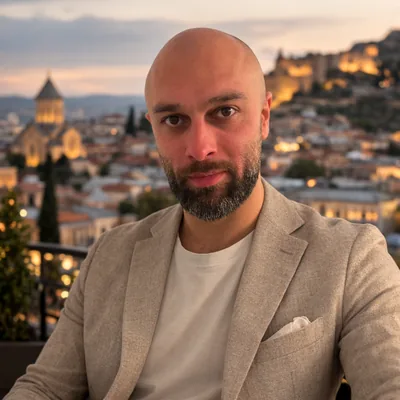
George Chkhartishvili

George Chkhartishvili

Independent Investment Advisor, Tbilisi

  • 20+ years in business management (Georgia, Russia, CIS)
  • 5 years in investment advisory
  • 20+ completed projects in Georgia over 6 years

Former Managing Director of AKFA Holding Georgia office

7 Kote Marjanishvili St, Tbilisi 0102LinkedInTrack Record

Write to me directly — let's talk through your idea

A first conversation — to understand the task and define the next step.

What matters to me first is getting to know you: your experience, your goal, and your context. Sometimes, after just one conversation, it becomes clear where it makes sense to look next.

And if I see that I can genuinely be useful, we'll separately work out the format, the scope of my involvement, and the fee.